In a recent poll, The Brennan Center for Justice found that 65% of voters believe campaign contributions from billionaires cause corruption in politics.
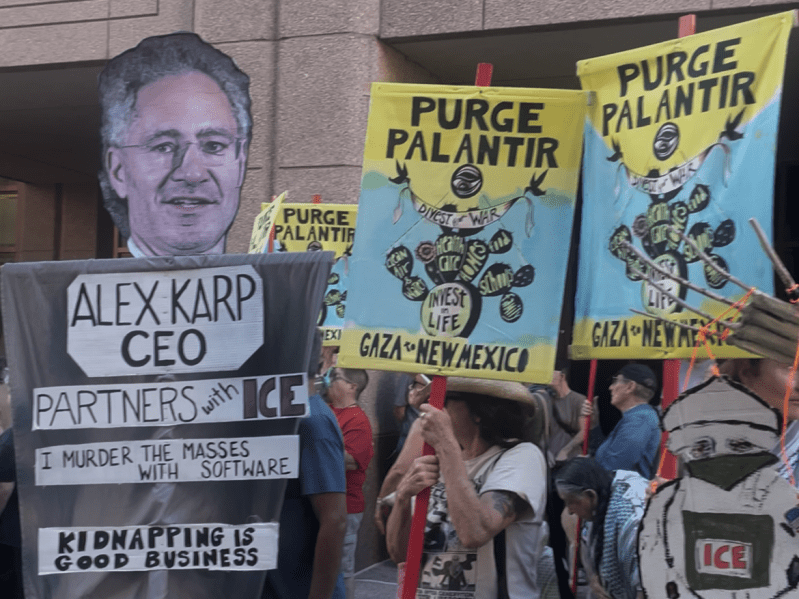
On Sept. 10, dozens of demonstrators from over 30 community organizations took to the streets of Albuquerque to pressure New Mexico’s congressional delegation to reject campaign contributions from Palantir, a tech company with several controversial billionaire executives.
Community members hoisted puppets and tall signs that read “Purge Palantir: Gaza to New Mexico” while several speakers addressed the crowd outside Sen. Martin Heinrich’s (D) office in downtown Albuquerque.
“ Palantir is leading the world on an extremely dangerous trajectory,” said Sophie Laborwit, an organizer with Youth United for Climate Change Action (YUCCA). “They are the fusion of authoritarian government, corporate power, mass surveillance, and AI decision-making.”
Speakers decried Palantir’s various federal contracts that have provided AI-driven targeting for US military operations in Iran, Israel’s genocide in Gaza, and surveillance technology for Immigration and Customs Enforcement (ICE).
Jeff Haas, a civil rights attorney and co-founder of Santa Feans for Justice in Palestine, said in an interview with Courier New Mexico that Palantir represents the “worst of AI.”
“Palantir was involved in finding doctors and Palestinian journalists, and targeting them,” said Haas. “So I think they got a lot of blood on their hands participating with Israel in this genocide.”
What is the ‘Purge Palantir’ campaign demanding?
Purge Palantir is a national campaign organized by the American Friends Service Committee (AFSC) that’s pressuring all elected officials to reject campaign contributions from Palantir executives.
According to the group’s analysis of campaign contributions, executives from Palantir like Peter Thiel and Alex Karp have donated millions to political candidates since 2006 – mostly Republicans.
The protest was held outside Heinrich’s office because of campaign contributions from Palantir executives in 2024 totalling more than $20,000 according to Federal Election Commission (FEC) filings.
In a statement sent to Courier New Mexico, a Heinrich spokesperson said the senator hasn’t accepted any contributions since and “has no intention” of doing so moving forward.
When asked about returning or donating the campaign contributions as activists demanded, Heinrich’s spokesperson wrote: “Given strict reporting and compliance requirements for campaigns by two-year cycle, the Senator’s campaign does not revisit contributions received in prior cycles.”
How Palantir donations are surfacing in the 2nd District race
While speaking to the crowd, Laborwit called on US Rep. Gabe Vasquez (D), who serves on the House Armed Services Committee, to publicly support the pledge to reject Palantir contributions.
In a statement sent to Courier New Mexico, Vasquez’s campaign manager Patricia Soccarras Santiago confirmed that he has not accepted contributions from Palantir “or other companies whose actions raise serious concerns about human rights violations and abuses of power.”
According to FEC filings, the only congressional candidate in New Mexico who received contributions from a Palantir executive this election cycle is former police detective Greg Cunningham, running against Vasquez in New Mexico’s 2nd Congressional District.
The close race between Cunningham and Vasquez has drawn national attention from high-profile Republicans attempting to flip the seat to keep their slim majority in the House of Representatives.
Palantir Chief Technology Officer Shyam Sankar contributed $7,000 to Cunningham’s campaign. According to Purge Palantir, Sankar has mainly donated millions to Republican candidates during his tenure at Palantir.
In media appearances, Sankar has applauded the Trump administration’s adoption of AI for the Pentagon and compared opposition to data centers to “suicide” for American prosperity.
Greg Cunningham’s campaign did not respond for comment prior to publication.
“ Palantir wants to stay a little bit under the radar because they’re aware that they’ve been targeted,” Haas told Courier New Mexico.
“ But I think it’s significant: would you take campaign money from somebody who was carrying out genocide?”