New Mexico families have spent thousands more on everyday essentials since President Donald Trump returned to the White House, according to a new analysis from congressional Democrats, as rising New Mexico gas prices, grocery bills and housing expenses continue to pressure household budgets.
The Democrats on Congress’ Joint Economic Committee released a fact sheet this month estimating that the average New Mexico household has faced more than $3,800 in additional expenses since Trump took office in January 2025. The committee’s Democratic staff attribute the increases in part to the administration’s tariffs and war with Iran.
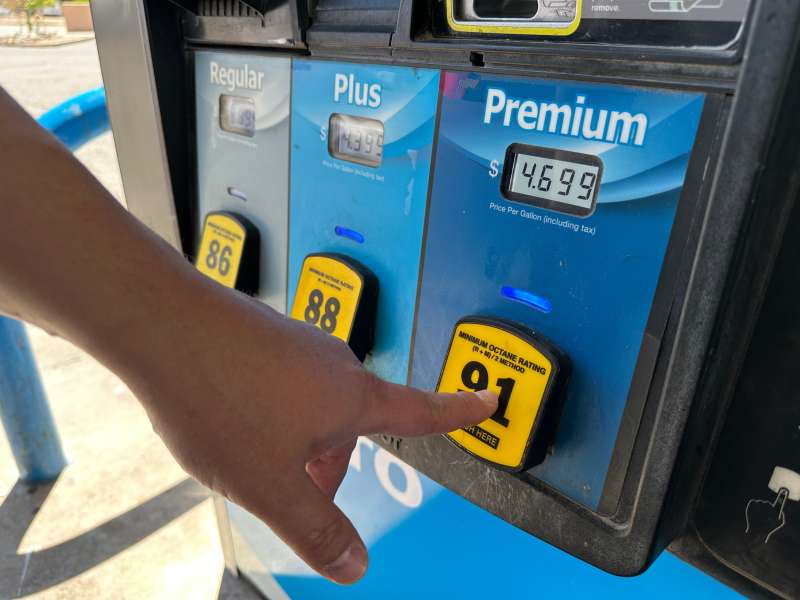
“Trump promised to lower costs, but his war with Iran has driven gas prices up to nearly $4.40 a gallon and diesel above $6 in New Mexico,” Sen. Martin Heinrich, a member and former chair of the committee, said in a statement accompanying the report on Oct. 20. “His tariffs have made the cost of groceries and everyday essentials more expensive, forcing families to pay more than $3,800 extra just to cover the basics.”
Heinrich’s statement also estimated that families are paying $980 in additional gas costs since the war with Iran began, $476 in housing expenses, and $70 in electricity costs in 2025. It also cites $310 in extra grocery spending, a national figure.
New Mexico saw the second-largest jump in gas prices in the country over the past year. The statewide average hit $4.47 a gallon on Oct. 6, up nearly 54% from $2.90 a year earlier, according to a LendingTree analysis of AAA data.
The Bureau of Labor Statistics’ September Consumer Price Index report released Oct. 14, found that consumer prices nationally rose 3.7% over the preceding 12 months. Energy prices increased 20.4% over that period, while gasoline prices rose 34.2%. Gasoline prices alone jumped 9.1% in September, accounting for more than half of that month’s overall inflation increase.
Meanwhile, Kevin Hassett, Trump’s director for the National Economic Council (NEC), told NewsNation on Oct. 21 that while the consumer price index (CPI) revealed higher costs, he considers them to be “temporary.”
How are New Mexico gas prices hitting farms?
For farmers and ranchers, higher fuel prices can affect more than the cost of filling a vehicle. Diesel powers agricultural equipment and trucks that move crops and livestock, while fuel and tariffs can also affect the cost of fertilizer, machinery and other supplies.
Luis Soriano, a spokesperson for Heinrich, told Courier New Mexico that the senator recently met with New Mexico farmers and ranchers who described the financial pressure they were facing.
“We actually had an event with farmers, and the number one thing that they kept saying was the tariffs made all their equipment and everything more expensive, fertilizer more expensive, and, of course, they rely on diesel for transporting their vegetables and everything that they grow,” Soriano said.
Those higher production and transportation costs can also put pressure on food prices, although the extent to which individual costs are passed along to consumers varies.
The committee’s fact sheet found that grocery prices nationally were more than 4% higher than when Trump took office. It also cited ground beef prices exceeding $7 per pound and coffee prices topping $9 per pound.
Soriano said Heinrich believes the administration should reverse course on its policies to provide relief.
“The senator thinks that if Trump is serious about lowering costs, he needs to end his war and end his illegal tariffs, which have made the construction of houses more expensive [things like] lumber, tools, electronics, medical supplies.”
The Supreme Court ruled 6-3 on Feb. 20 that the International Emergency Economic Powers Act (IEEPA) does not authorize the president to impose tariffs, though other tariffs may remain in effect under separate legal authorities.
Can New Mexico paychecks keep up?
The additional costs outlined in the report span expenses that many households cannot easily avoid. Families need housing, food, electricity and transportation regardless of whether their wages maintain pace with inflation. Wages unfortunatlely haven’t kept up with rising prices: real national average hourly earnings fell 0.7% over the year ending in September 2026, according to the Bureau of Labor Statistics.
Soriano said the senator’s office has heard concerns from people across the state about the combined pressure of those expenses.
“The senator believes that New Mexico families deserve relief, and that starts with ending the war and ending the tariffs, period, point blank,” Soriano added.