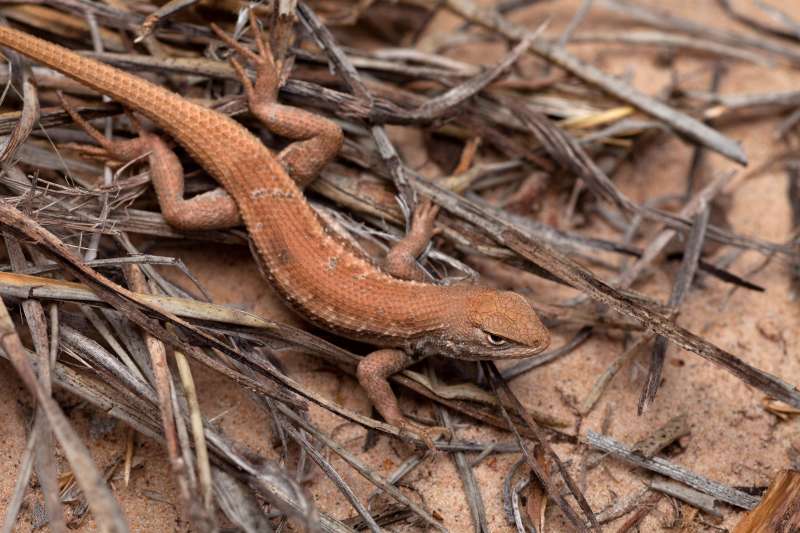
For decades, a battle over the nation’s largest oil field has centered around an extremely rare reptile: the dunes sagebrush lizard. This summer, the Trump administration handed oil and gas companies a huge win by rolling back federal protections for the lizard.
The dune sagebrush lizard’s natural habitat in southern New Mexico is very unique: they live and breed in dunes formed by desert winds, and shinnery oak trees offer the only cover from the sun. Experts say that the lizards’ environment is particularly prone to disruption from oil and gas drilling operations in the Permian Basin.
Serving as an ecological indicator species for the Permian Basin, the lizard’s health signals the overall collapse or stability of the region’s fragile dune ecosystem.
The Center for Biological Diversity (CBD) has been advocating for protections for the dunes sagebrush lizard and other “imperiled species” in the Permian Basin since 2002.
“We will not rest until the dunes sagebrush lizard and lesser prairie chicken are fully protected and on the road to recovery,” wrote Jason Rylander, senior attorney for CBD, in an email statement to Courier New Mexico. “We don’t have to drive species to extinction to provide energy to Americans. And we shouldn’t.”
In 2010, they attempted to have the lizard classified as “endangered” by the Fish and Wildlife Service, but it was ultimately shot down.
In 2024, the Biden administration changed the lizard’s status to “endangered” because of habitat destruction and increasingly hotter temperatures due to climate change. The rule noted that 35% of the dunes sagebrush lizard’s environment was unlivable for them.
Beyond traditional oil rigs, the boom in mining across the Permian Basin—which generates roughly 40% of all U.S. crude oil—has stripped away thousands of acres of the fragile dune habitat the lizard relies on for survival.
Trump and Texas fight to reclassify
Immediately after the reclassification, Texas Attorney General Ken Paxton sued. He argued that the Service had violated the Endangered Species Act and directly tied it to Texas oil and gas companies’ revenue.
A couple weeks ago, the Trump administration settled with Texas instead of defending the 2024 rule. The US Department of Justice submitted a court filing in addition to the settlement that clarifies the Biden-era protections as a “serious and fundamental” error.
The Center for Biological Diversity responded to the claims as “nonsense.”
“The Service knows full well that habitat restoration has never been attempted at any scale meaningful to the recovery of the species,” wrote Rylander. “And their own filings admit as much.”
As part of the settlement, the dunes sagebrush lizard’s endangered status and environmental protections were reversed.
CBD will be pursuing an appeal to the decision to more rigorously defend the 2024 listing, in addition to two other species protection cases that were rolled back under the Trump administration.
“It’s clear that sound science is being sacrificed to politics.”