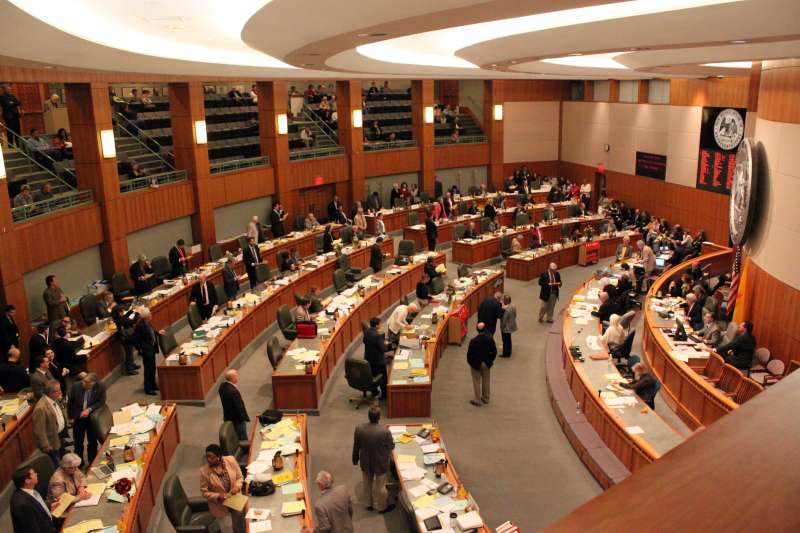
For more than a century, state legislators have served without regular pay—until voters approved a New Mexico lawmaker salary this November, ending the state Legislature’s status as the last unsalaried legislature in the country. It’s a part-time body whose members are expected to balance public service with jobs, families and the cost of traveling to Santa Fe.
That will change in 2029.
Voters approved Constitutional Amendment 4 on Nov. 3 with about 62% of the vote, according to unofficial returns, allowing lawmakers to receive compensation tied to the state’s median household income. The Legislative Finance Committee estimated that figure at about $67,800, which would cost the state roughly $7.6 million a year. Lawmakers will also keep their per diem and mileage reimbursements.
University of New Mexico political science professor Tim Krebs told KUNM before the lectionthat compensation could expand the pool of people who consider serving, particularly those who can’t afford to step away from their jobs for weeks at a time.
“One of the main barriers to people serving in the legislature is that it’s unpaid.” Krebs told KUNM.
But will a roughly $68,000 salary be enough to bring more teachers, nurses, small-business owners and other working New Mexicans into the Roundhouse?
Why did voters approve a New Mexico lawmaker salary?
A 2023 study by the University of New Mexico’s Bureau of Business and Economic Research surveyed lawmakers in 2022 about the demands of legislative service, and 43 of the 112 members responded. About 90% said they worked at least 30 days a year sans compensation. Some said they spend over $10,000 on gas, lodging and vehicle maintenance for official duties. One legislator said they incurred nearly $40,000 in expenses during a single session.
The study also found that 80.7% of those who answered did not believe they had enough time to complete the work required of them. Nearly 83% said legislators should be paid a salary. About 77% said per diem and mileage didn’t cover their expenses.
New Mexico’s legislative calendar adds another complication. Lawmakers meet for 30-day sessions in even-numbered years and 60-day sessions in odd-numbered years, but their responsibilities don’t stop when the sessions close. They also serve on interim committees, meet with constituents and prepare legislation throughout the year.
What won’t a New Mexico lawmaker salary fix?
Campaigning still costs money. New Mexico campaign-finance disclosures show legislative candidates raised nearly $6.7 million and spent about $4.7 million during the 2026 election cycle. Those totals include candidates who lost.
And the amendment does not, by itself, guarantee that private employers will provide workers with paid leave to campaign or serve in office. Someone who earns a salary as a legislator may still have to navigate the consequences of leaving a job, arranging child care or maintaining another source of household income.
Opponents, including the Rio Grande Foundation, argued the salary would stack on top of lawmakers’ existing per diem and pension benefits without showing it would make the Legislature work better.
“We have a lot of people in the legislature who are retirees or who are independently wealthy or have jobs that just allow them to serve because they’re more flexible, and so forth,” Krebs said. “Paying a person for their service in the legislature should broaden that pool of people who first think about running, want to get involved, and then who eventually serve, and that’s probably to the benefit of the state.”