Cats and dogs may be the most popular pets, but they’re far from the only animal companions people welcome into their homes. Some pet owners prefer smaller, lower-maintenance animals like fish or hamsters, while others are drawn to more unusual pets. In New Mexico, several exotic animals can legally be kept as pets, ranging from unique reptiles to fascinating small mammals.
That said, owning an exotic animal comes with responsibilities that differ from caring for a traditional pet like a cat or dog. Many exotic animals require carefully controlled habitats and species-specific care. Finding veterinary care can also be more challenging, since not all vets treat exotic animals.
This post covers seven exotic pets you can legally own in New Mexico, along with key information about their care, temperament, and needs. Keep reading to discover which exotic pet might be the right fit for you.
1. Axolotl
Axolotls have surged in popularity in recent years thanks to social media, video games, and their famously “smiling” appearance. Native to the lakes and wetlands around Mexico City, these unique amphibians are a type of salamander that remain fully aquatic throughout their lives rather than transforming into land-dwelling adults.
Axolotls typically measure between 6 and 18 inches long and weigh between 2 and 8 ounces. They have “feathery” external gills, flat heads, and a wide range of colors, including the pinkish-white albino varieties commonly bred in captivity.
Axolotls also have a remarkable regenerative ability. They can regrow limbs and even parts of major organs, making them an important species for scientific research, as well as a highly sought-after exotic pet.
Need to know in New Mexico: Axolotls are legal to own in New Mexico, but you’ll need a permit from the New Mexico Department of Game and Fish. Additionally, it’s illegal to import an axolotl from other states, so be sure to obtain yours locally.
Care tips: While many groups advise against keeping axolotls as pets, if you’re going to do so, there are specific care instructions you should follow in order to keep yours safe. You’ll need:
- A 30 to 40-gallon tank with a lid
- A strong filter system and frequent water changes
- To maintain a water temperature between 60 degrees and 68 degrees Fahrenheit
- A low-light environment (Axolotls lack eyelids, making them sensitive to light, and too much light exposure can cause stress or discomfort.)
- To handle your axolotl very minimally (They have very sensitive skin, and too much handling can damage their slime-skin barrier and make them more susceptible to infections.)
Life expectancy: Axolotls can live between 10 and 15 years with proper care.
2. Bearded dragon
Bearded dragons are one of the most popular pet lizards, particularly because they have a calm temperament and are easy to handle. Hailing from the deserts and scrublands of Australia, these reptiles typically grow between 18 and 22 inches long.
Bearded dragons, often called beardies, get their name from the spiky “beard” beneath their chin, which can puff up and darken when they feel threatened or territorial. Unlike many reptiles, bearded dragons are often relaxed around people and can form surprisingly strong bonds with their owners, with some even seeming to enjoy cuddling.
Although they’re technically venomous, their mild venom is harmless to humans and usually causes only minor irritation if bitten. Beardies are quick and agile when startled, and they can sprint short distances on their hind legs (though this is more commonly seen in the wild).
Need to know in New Mexico: Bearded dragons are legal to own as pets in New Mexico and don’t require a permit.
Care tips: Bearded dragons are generally considered to be easy pets, but they do require some special equipment and care. Here are a few things to keep in mind:
- You’ll need to purchase a tank that’s at least 40 gallons for adult beardies
- The enclosure should have a warm and cool side (kept at about 100 degrees and 75 degrees Fahrenheit, respectively), and each side should feature a hiding area
- The tank should also feature an incandescent light or ceramic heater to help your beardie regulate its body temperature and a UVB light to help it absorb vitamins and minerals
- A basking rock or climbing branch is a nice addition to consider for your beardie’s home
- Male beardies should never share a tank (they’ll get aggressive toward one another)
- You should feed your pet a diet of insects, vegetables, and fruits (younger beardies need more protein and less produce than older ones)
- Fireflies, onions, and mushrooms are toxic to beardies (avocados, spinach, beet greens, and rhubarb should also be avoided)
Life expectancy: Beardies can live anywhere from 7 to 15 years in captivity.
3. Central American boa constrictor
Central American boa constrictors are non-venomous snakes native to the tropical forests of Central America. They usually grow to be between five and eight feet long and have a cream, gray, or brown coloration with dark saddle-like patterns.
These boas are generally calm and relatively easy to handle, making them popular pets. Younger boas spend more time climbing trees, while adults become more ground-dwelling with age (due to their increased weight).
Need to know in New Mexico: While all venomous snakes are illegal to own in New Mexico, you can keep non-venomous snakes, such as the Central American boa constrictor, as a pet. You don’t need to obtain a special permit.
Care tips: The Central American boa is one of the most commonly kept pet snakes, due in large part to its calm temperament and manageable size. That said, you’ll need to purchase some special equipment and food if you plan to have one as a pet. Items you’ll need to buy before bringing home your pet boa include:
- A large enclosure with a lid (The Spruce Pets suggests a cage that’s at least the length of your snake when it’s full-grown, so that it has room to stretch out.)
- Heat lights to help your snake regulate its internal body temperature
- Additional lighting to mimic the 12-hour cycle of the snake’s natural habitat
- Mice to eat (frozen and thawed or live)
- A large water bowl that can double as a place to soak and a source of humidity
Life expectancy: If you care for your pet boa properly, it can live a very long life—between 20 to 30 years.
4. Chinchilla
Chinchillas are rodents native to the Andes Mountains of South America. They have the densest fur of any land mammal, which helps protect them from cold mountain climates but also means they can overheat easily in warmer locales like New Mexico.
Chinchillas are crepuscular animals, which means they’re most active around dawn and dusk. They’re relatively small animals, usually growing to about 10 inches long (excluding their tail) and weighing less than two pounds.
Need to know in New Mexico: You can own a pet chinchilla in New Mexico without a permit.
Care tips: Chinchillas can make good pets, but they have some specific housing and dietary needs to consider:
- Chinchillas are social animals, so if possible, you should adopt more than one
- They are very sensitive to heat and require a cool living environment (ideally between 65 degrees and 80 degrees Fahrenheit)
- Chinchillas are very active, acrobatic animals requiring a spacious cage, preferably with multiple levels
- An exercise wheel is also essential to prevent boredom, but make sure it’s a chinchilla-specific wheel (sometimes called a chin-spin)
- Pet-safe wood blocks will help wear down your pet’s continuously growing teeth
- Paper-based bedding is best because it’s gentle on the soles of the chinchilla’s feet
- Hay is an important part of a chinchilla’s diet, and they should always have access to some
It’s also important to remember that chinchillas should never be bathed in water. Instead, they require daily dust baths (be sure to purchase commercial chinchilla dust).
Life expectancy: On average, pet chinchillas have a life expectancy between 10 and 15 years.
5. Hog Island boa constrictor
Hog Island boa constrictors are a rare boa species found only on Cayos Cochinos (Hog Islands) off the coast of Honduras. They feature faded patterns, a soft pink, peach, or orange coloration, and usually grow to be between four and six feet long.
Because of their isolated island habitat, Hog Island boas evolved differently from mainland boas, spending more time in trees and relying more heavily on birds as prey. They’re also famously docile, likely due to having very few natural predators in the wild, which makes them especially tolerant of handling compared to many other snake species.
Need to know in New Mexico: Similar to the Central American boa constrictor, you can own a Hog Island boa constrictor without a permit in New Mexico.
Care tips: Caring for a Hog Island boa constrictor is similar to caring for a Central American boa constrictor. Follow these guidelines from Island Life Exotics to create a comfortable home for your boa:
- Select a large enclosure that can contain humidity well
- The enclosure should have a hot and cold side to help your boa regulate its body temperature
- Maintain a high humidity level in the enclosure
- While not necessary, you may want to set up lighting in the enclosure and schedule it to mimic day and night (Your boa may also enjoy basking in the light.)
Don’t forget that boas eat much less frequently than other pets. Young boas should eat about once every 10 to 14 days, with feeding spaced out even further as the snake ages.
Life expectancy: Between 20 and 30 years
6. Short-tailed opossum
Short-tailed opossums are small marsupials native to South America. They have gray-brown fur, large ears, bright nocturnal eyes, and a hairless tail that helps them grip branches and objects.
Unlike most marsupials, short-tailed opossums don’t have a pouch for carrying their young. When raised around people from a young age, they are often friendly, curious, and easy to handle, making them increasingly popular as exotic pets.
Need to know in New Mexico: You can keep a short-tailed opossum as a pet in New Mexico, but you must obtain a permit first.
Care tips: Short-tailed opossums have become a pretty popular pet due to their cleanliness and cute appearance. If you’re planning to keep one as a pet, there are a few things you need to know first:
- Short-tailed opossums have a tendency to fight with each other, so they do best as solitary pets
- They’re escape artists, so you need to carefully consider your enclosure type (The Spruce Pets suggests an aquarium with a lid or a mesh wire cage.)
- Make sure the enclosure has plenty of branches for climbing and bedding, such as shavings or corn cob litter
- You have plenty of options when it comes to feeding your opossum, including commercially manufactured dry food, live insects, and fruit, but overall, its diet should be high in protein and low in fat
- They can become dehydrated quickly, so make sure your pet always has access to fresh, clean water
Life expectancy: Short-tailed opossums have a shorter life expectancy than other pets in this roundup (between 4 and 6 years).
7. Sugar glider
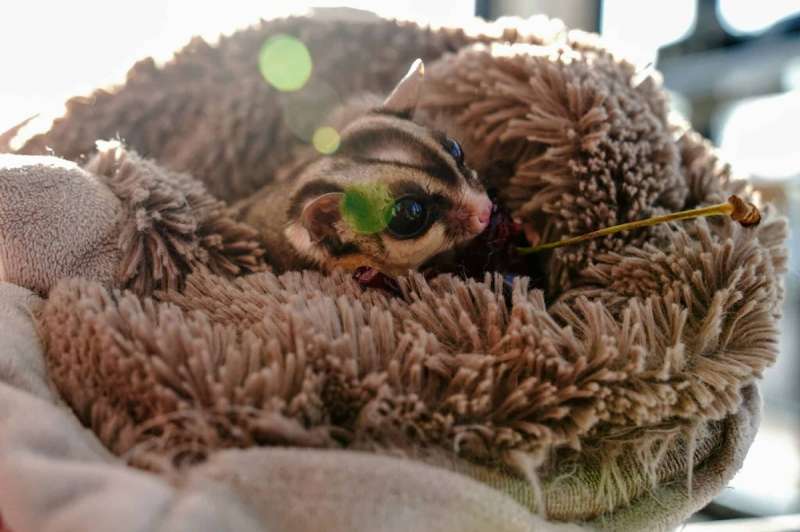
Sugar gliders are tiny, tree-dwelling marsupials native to Australia, Indonesia, and Papua New Guinea. They are best known for their ability to glide through the air using a thin membrane called a patagium that stretches between their wrists and ankles.
These highly social animals live in colonies and spend their nights gliding between trees in search of nectar, sap, and insects. Their soft fur, large eyes, and playful personalities have made them popular exotic pets, though they require plenty of social interaction.
Need to know in New Mexico: You can legally keep a sugar glider as a pet in New Mexico, but you’ll need to obtain a permit first.
Care tips: According to Chewy, sugar gliders don’t make great pets. They’re wild animals, after all, and their natural environment is difficult to replicate at home. If you still have your heart set on adopting one, keep the following in mind:
- Sugar gliders are nocturnal, meaning they’re mostly active at night
- You should adopt more than one sugar glider, or yours may become depressed and exhibit signs of stress, such as self-harm
- Sugar gliders need space to explore, so you’ll want to purchase a large enclosure with hiding places and enrichment toys (New Mexico Sugar Glider shares some helpful housing tips here.)
- They require a special diet, ideally consisting of vegetables, fruits, and insects, and a high-protein supplement made in Australia
Life expectancy: Pet sugar gliders can live between 10 and 15 years if they’re well taken care of.
This article first appeared on Good Info News Wire and is republished here under a Creative Commons license.